

Minimising Impacts
Mountsorrel Quarry
As part of the local community, we want to ensure we are a good neighbour to people living or working in Quorn, Mountsorrel and surrounding areas.
Air quality and dust
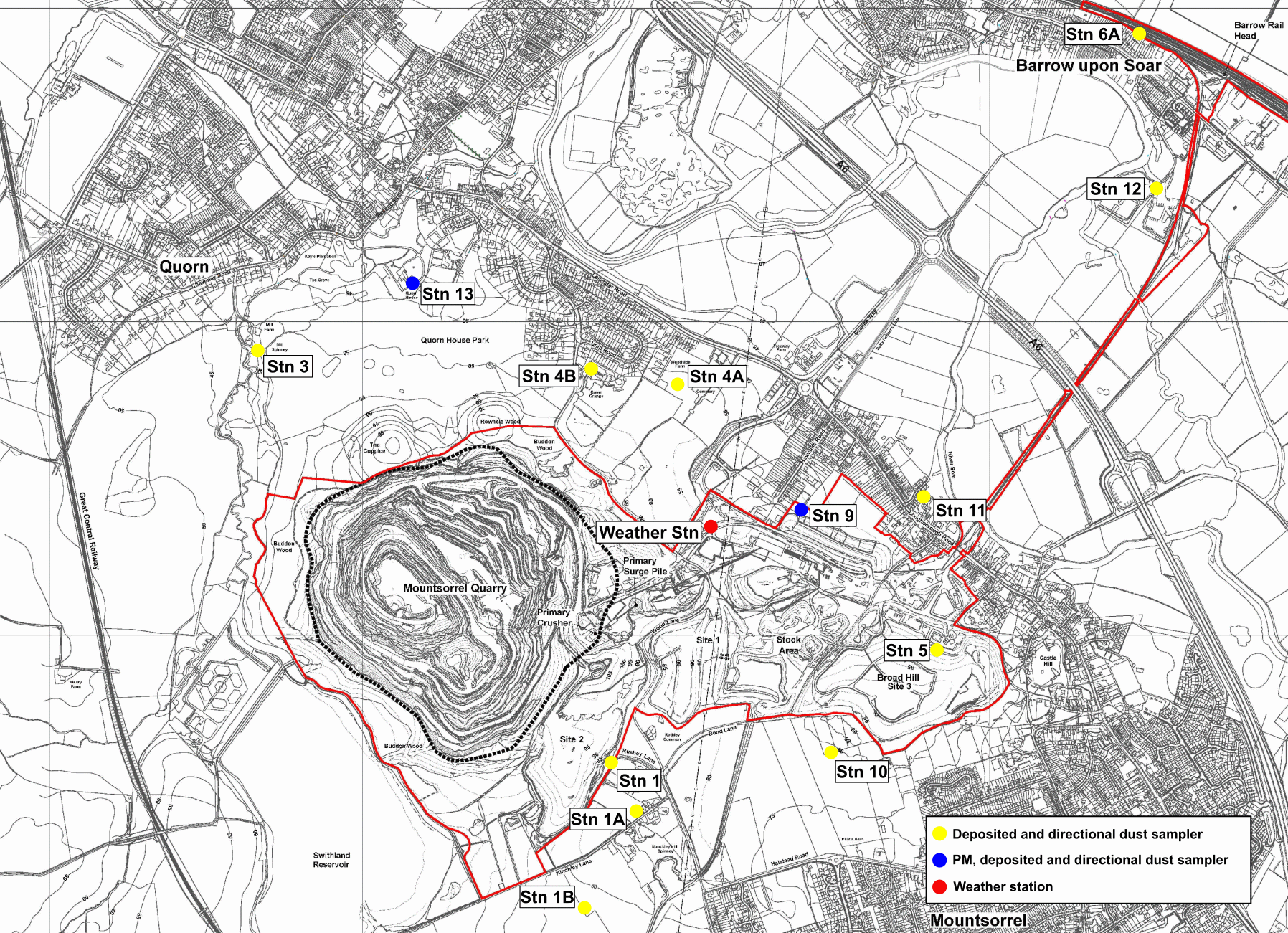
We commission an independent company, DustScanAQ, to measure air quality and dust at 22 locations around Mountsorrel Quarry – mostly in residential areas. This monitoring lets us fully understand the impact of our operations and take action if required. In addition to monitoring for fine particulate matter, we also monitor visible dust levels, as, we recognise that this can cause annoyance, and we want to reduce it as much as we can.
Both our monitoring by DustScanAQ, and the monitoring by Charnwood Borough Council, show that air quality in the areas surrounding the quarry are within the relevant Air Quality Objectives as set by the UK government.
You can find out more about what we monitor, and our most recent quarterly monitoring results, here:
- Our impact on air quality: an overview Download PDF
- Our impact on air quality: technical explanation from our air quality consultants, DustScan Download PDF
- Our monitoring results (plus non-technical review): November 2023 to February 2024 Download PDF
- Our monitoring results (plus non-technical review): February to May 2024 Download PDF
- Our monitoring results (plus non-technical review): May to August 2024 Download PDF
- Our monitoring results (plus non-technical review): August to November 2024 Download PDF
- Our monitoring results (plus non-technical review): November 2024 to March 2025 Download PDF
If you want access to our monitoring results from earlier than November 2023, please email us at [email protected].
Charnwood Borough Council also publishes its own independent monitoring of the air quality around Mountsorrel Quarry. This is available here. The Council has a statutory obligation to revoke the Air Quality Management Area around Mountsorrel Quarry as pollution levels have dropped below the legal limit for five consecutive years. However, the Council continues to have a legal obligation to monitor air quality in the area and we will continue to extensively monitor air quality and publish the results on the website. To see where our monitoring locations are situated click here.
We built a new screenhouse that came into operation in early 2024, following a fire to the old screenhouse in late 2022. It now completely encloses our mineral processing operations, and features the latest technologies, including an internal dust suppression system and additional cladding. These features seal the unit more effectively compared to the previous screenhouse. With the new screenhouse in full operation, we can also remove the mobile processing plant. In combination with the new primary crusher lower down in the quarry, this will reduce dust and noise from the quarry processing operations.
In August / September 2023, we hosted two webinars to update residents on our work around dust management. You can view a recording of one of the sessions here.
We host research work by Professor Francis Pope from the University of Birmingham in order to try and improve our measurement and understanding of PM sources. To read our published paper on air quality management, click here.
Blasting
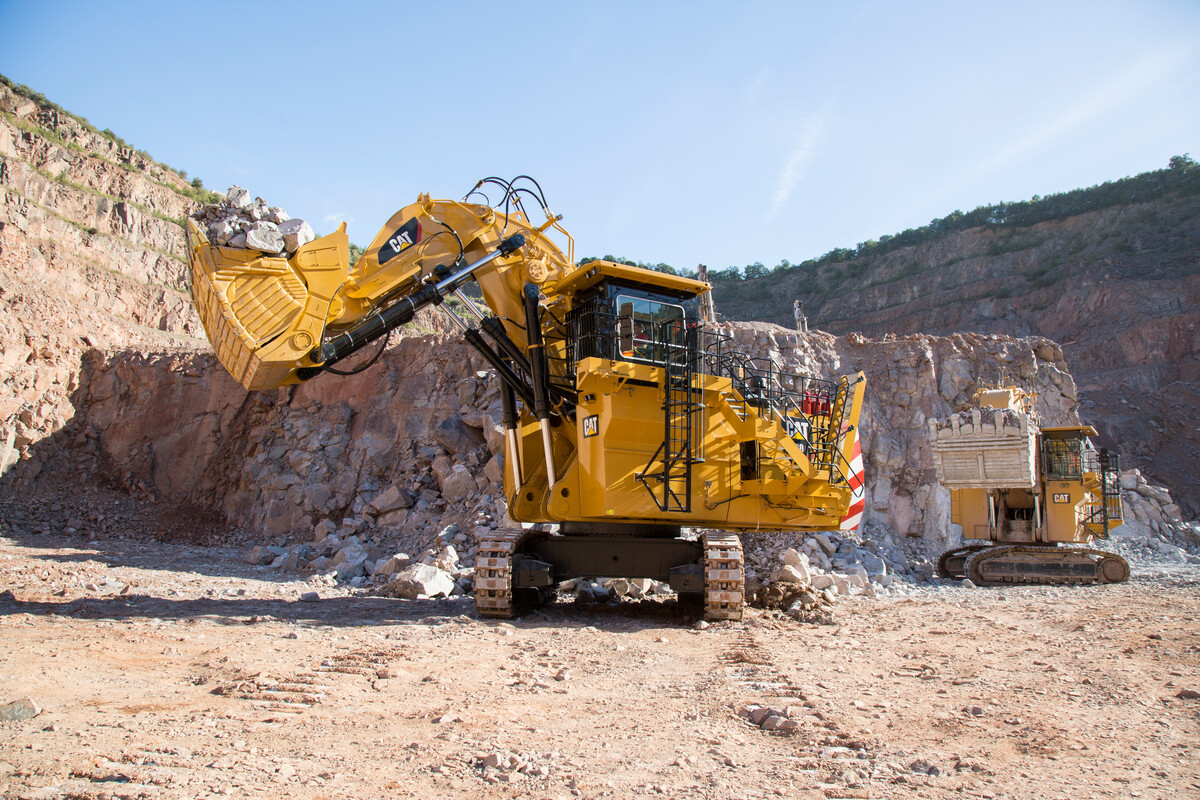
Blasting has been taking place at Mountsorrel Quarry for 250 years. To extract the granite from the ground, we must first remove the overburden that lies on top to expose the bare rock. Once the rock is exposed, our experienced explosives team drills holes into the surface and inserts explosives so that we can break the rock from the ground.
During blasting, the explosives are detonated in a predetermined sequence so that there are delays of a few milliseconds between each hole. The delay means the shock waves generated not only direct much more energy into breaking up the stone effectively (and less into sound and air vibration), but also create much lower levels of ground vibration in the surrounding area.
Each blast at the quarry is performed by a fully trained expert and must adhere to the strict safety and environment standards set by the Health and Safety Executive and Leicestershire County Council. Each blast is a carefully controlled detonation, designed in advance. Vibrations are monitored with a mobile vibrograph machine, and the blasting process proactively reviewed to minimise impact. We proactively plant trees and construct soil mounds to muffle the sound of the blasts and reduce the visual impact of our operations on the landscape.
Blasting can be carried out on the site at any time between 11am and 4pm, but is typically scheduled for 12.30pm. If we need to change the time from 12.30pm, we contact local parish officers, along with anyone who is signed up to our contact database to let them know.
To sign up for our contact database to receive alerts on blasting time changes, please email [email protected]
Noise
To reduce the noise coming from the site, we use a range of techniques to help limit noise: noise barriers (such as soil mounds known as bunds), acoustic panels, enclosing operational equipment, and industrial silencers to dampen the noise. Our new screenhouse, which encloses our mineral screening operations, has additional cladding to mitigate against noise as well as dust.
The quarry has a noise control programme in place, which is agreed and reviewed with Leicestershire County Council and Charnwood Borough Council. Four times a year we do 24-hour continuous monitoring at selected residential properties to check if the noise that can be heard at these properties is within the acceptable levels. We also conduct routine 24-hour environmental noise measurement on site and at the site boundary, including close to the asphalt plant and aggregate loadout areas, which highlight any potential noise concerns during sensitive operating hours.
Our noise monitoring reports are then discussed with Charnwood Borough Council, Leicestershire County Council and the quarry liaison group.
Measurement, assessment and control of quarry noise has been carried out by external consultants Vibrock since the early 1990s.
Water monitoring
Surface water discharged to the River Soar and Swithland Reservoir is regularly monitored by our environmental technician. It is their job to make sure the discharges meet Environment Agency standards. As the bottom of the quarry is 127 metres below sea level in solid granite, there is no need for groundwater monitoring.
Did you know?
- Our 24-hour weather station continuously monitors and records wind direction and speed, rain and snowfall, temperature, humidity and air pressure.
- Over 450 dust samples are taken every year on and around Mountsorrel Quarry.
- Noise levels on and around the site are recorded every second.
- Monthly environmental monitoring data is shared with Leicestershire County Council and Charnwood Borough Council and is discussed at quarterly community liaison group meetings.
Sustainability
We have invested millions of pounds at Mountsorrel in the latest technology, with investments in recent years including:
A new primary crusher (which breaks up the granite):
- Powered by electricity from 100% renewable sources
- Crushes the mineral faster, driving efficiency
- Reduces the level of noise and dust, with improved dust suppression systems
A new screenhouse (where the granite is processed and graded):
- Completely encloses our mineral screening operations, reducing noise and dust
- Includes a new internal dust suppression system
- Additional cladding more effectively seals the building
- We have also re-trained our team on site, as the equipment is more technologically advanced